
If you trade, import, or process agricultural commodities like coffee, cocoa, nuts, or dried fruits, you have probably come across the term CTRM.
CTRM stands for Commodity Trading and Risk Management, and it refers to a category of software designed specifically for businesses that buy, sell, and move physical commodities.
Unlike general-purpose business tools, a CTRM is built to handle the complexity that comes with commodity trading: fluctuating market prices, multi-origin sourcing, shipment tracking across oceans, quality variations by lot, and the financial instruments used to hedge price risk.
In practical terms, a CTRM helps commodity businesses manage contracts, shipments, inventory, pricing, and risk in one system.. If you are wondering whether your company needs one, take a look at our guide on how to choose the right CTRM.
The best way to understand a CTRM is to follow a real trade from start to finish.
Imagine a coffee importer in the United States who buys 250 bags of organic green coffee from a supplier in Colombia. The journey starts with a purchase contract that captures the product description, origin, quantity, delivery period, price basis (say, FOB Bogota), and payment terms. The CTRM records all of this and makes it the foundation for everything that follows.
Next comes logistics. Once the coffee is shipped, the system tracks the bill of lading, vessel name, ETA, container information, and shipping marks. As the shipment moves, the inventory status transitions automatically: from AFLOAT to AT DOCK to IN STORE. The importer always knows where the coffee is and when it will arrive.
When the coffee arrives at the warehouse, the importer can allocate it to a buyer, generate delivery orders, track unallocated inventory, and feed the transaction into profit and loss reporting. On the sales side, the importer may begin selling the coffee before it is fully received, whether the product is still OPEN, AFLOAT, AT DOCK, or already IN STORE.
The CTRM tracks these sales contracts and manages allocations, which reserve specific quantities from the original purchase against one or more customer sales. This gives the importer a clear view of what has been committed, what remains available, and how each sale ties back to the underlying purchase. As quantities are delivered or released, the system also supports invoicing based on the sales contract terms, helping ensure that pricing, quantities, and customer charges are recorded accurately.
On the financial side, the importer may need to fix the price against the New York "C" futures exchange and apply a differential. The CTRM handles this through price fixation records and hedge management tools, connecting each physical contract to its corresponding futures position.
This is where a CTRM platform becomes valuable, because it brings the full workflow into one system. Eximware’s PartnerXM is built to support that process from contract through delivery, invoicing, and reporting.
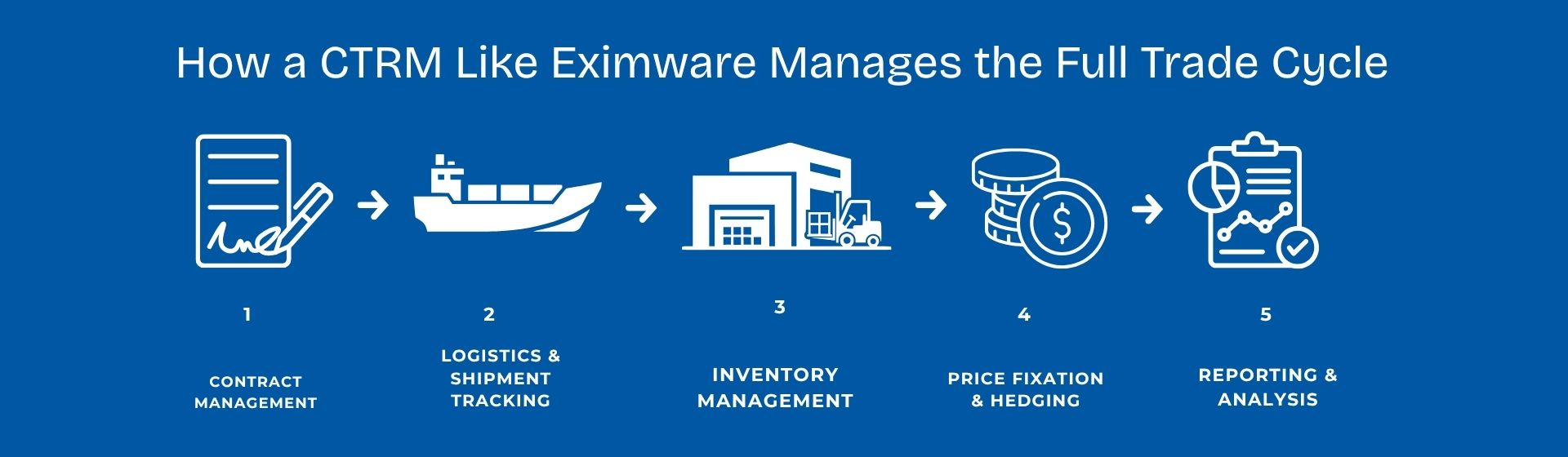
While every CTRM platform is different, most share a common set of capabilities that cover the full trade lifecycle:
A CTRM captures both purchase and sales contracts with all their specific terms: product type, origin, grade, quantity, pricing basis, delivery period, and counterparty details. Commodity contracts involve multiple shipments, provisional pricing, and amendments over time. A CTRM keeps all of this organized and auditable.
Once goods are in transit, the system tracks every stage of the shipment process: vessel and voyage information, ETAs, bill of lading details, container data, and customs documentation. Operations teams can see which shipments are on schedule and which ones need attention.
Commodity inventory is not like retail inventory. The same product can exist in multiple statuses (afloat, at dock, in store), across different warehouses, with varying quality grades and certifications. A CTRM provides real-time visibility into all of this, letting teams filter by origin, product class, location, and counterparty.
Many commodity contracts are priced against a futures exchange plus a differential. A CTRM manages the price fixation process, tracks hedge positions, and connects physical trades to their financial counterparts. This is essential for managing price risk and understanding your true cost basis.
From traffic status reports to sales position overviews, a CTRM consolidates data across the entire business into actionable reports. Teams can track open positions, monitor P&L by contract, and identify coverage gaps before they become problems.
Eximware has spent more than 25 years working exclusively with commodity businesses. Unlike platforms that try to cover every asset class from crude oil to electricity, Eximware focuses on agriculture and food commodities: coffee, cocoa, dried fruits, nuts, and spices.
The company offers two cloud-based products that work together:
That specialization means shorter implementation times, workflows that match how soft commodity businesses actually operate, and a team that speaks the same language as its clients.

